Puglia: Italy's Heel — Where Ancient Trulli Meet Baroque Cities and Authentic Food Culture
July 2026 · 8 min read
Puglia is where Italy tastes different. Trulli villages, baroque palaces, handmade pasta, and the kind of food tradition that hasn't changed in centuries.
Most people know Sicily. Fewer know Calabria. But Puglia — the heel of Italy's boot — remains one of southern Italy's best-kept secrets, and that's precisely why it's worth your time.
This is not the Italy of Renaissance paintings and ancient amphitheatres. This is something different: a region where food tradition runs so deep that recipes haven't changed in living memory, where handcraftsmanship is still the default, and where you can spend a morning watching an artisan make terracotta pots the same way his grandfather did.
The Trulli: A Landscape Unlike Anywhere Else
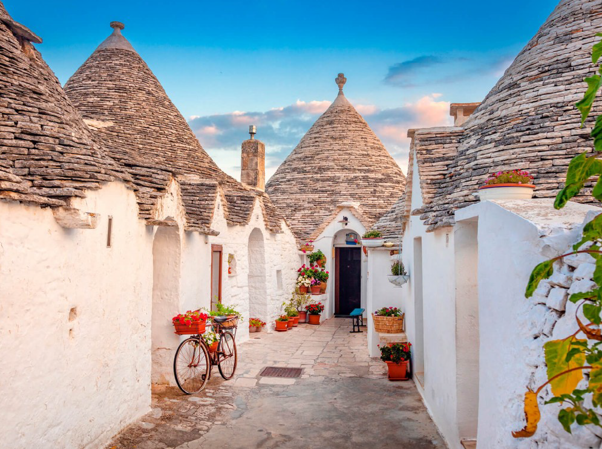
Alberobello, in the Valle d'Itria, is home to more than 1,400 trulli — distinctive whitewashed structures with pyramidal, conical, and domed roofs built from local limestone without mortar. It looks like something from a fairy tale, but there's nothing fantastical about it. This is genuine rural architecture, built because it was practical: the shape sheds water, the limestone stays cool, and the lack of mortar meant the stones could be reconfigured if the owner needed to move house.
A UNESCO World Heritage Site since 1996, Alberobello has somehow managed to avoid becoming a tourist trap. Yes, there are visitors. But walk past the main piazza and you'll find genuine artisans, functioning homes, and quiet cobblestone streets where the rhythm of daily life hasn't fundamentally changed.
The trulli district is remarkable not because it's a museum piece, but because it's genuinely alive.
The Food: Simplicity as Mastery
Apulian cooking is built on constraint. A region with limited arable land learned to make extraordinary food from what it could grow: durum wheat, tomatoes, eggplant, olive oil, cheese. There's no cream in the pasta sauces here. There's no butter. What you get instead is the kind of cooking that understands that the best meal often comes from respecting your ingredients rather than covering them up.
Visit an organic cheese farm and you'll taste mozzarella that tastes like milk — actually tastes like it — because it was made this morning and hasn't been sitting in plastic. Eat orecchiette (ear-shaped pasta) dressed with nothing but tomato sauce and aged Parmigiano and you'll understand why simplicity is sometimes the hardest thing to achieve.
The regional cured meat, Capocollo di Martina Franca, is salty, complex, and impossible to overeat — you taste it in small pieces with bread and wine, not sliced onto a plate. This is not food designed to fill you up. It's food designed to be understood.
Lecce: The Florence of the South
If Alberobello is rural and intimate, Lecce is urban and ornate. Known as the "Florence of the South," it's a city where nearly every building is dressed in elaborate Baroque and Rococo ornamentation — decorative façades, measured proportions, and the kind of architectural confidence that comes from centuries of prosperity.
But Lecce is not a museum. It's a working city where people live and work and eat. Walk through Piazza del Duomo — described as the elegant "living room" of the city — and you'll see locals taking coffee, university students walking to class, and the Cathedral of Maria Santissima Assunta rising above it all with quiet grandeur.
The city is also home to a centuries-old tradition of papier-mâché craftsmanship. Meet an artisan in his workshop and watch as humble material — water, glue, paper — gradually transforms into sculpture, decorative objects, and architectural elements that require real skill to create.
The Coastline: Drama and Accessibility
Polignano a Mare, on the coast, is built on limestone cliffs that drop directly into the sea. A boat tour reveals sea caves accessible only by water — towering arches, sculpted rock formations, and water so clear you can see the sea bed. It's the kind of coastline that photographs beautifully but is experienced far better in person.
Then there's Otranto, a medieval city that has served for centuries as a natural bridge between the Mediterranean and the Middle East. Walk through its ancient streets, visit the Cathedral of Santa Maria Annunziata, and you're standing above layers of history — Messapian, Roman, early Christian foundations all stacked beneath your feet. Inside the cathedral is an extraordinary 12th-century mosaic floor, the Tree of Life, crafted by the monk Pantaleone between 1163 and 1165. It's one of those artworks that rewards staring at for an uncomfortably long time.
The Intangibles: Why Puglia Matters
What makes Puglia different from other Italian food and wine destinations is not that it's undiscovered — it has been inhabited for millennia. It's that it hasn't been reconstructed for tourism. The trulli are not a theme park. The pasta is not served with a story about nonnas. The olive oil is not a luxury product marketed to the wealthy — it's what people cook with, what they've always cooked with.
There's an authenticity here that comes not from trying to be authentic, but from never having stopped being it.
Spend eight days in Puglia's Valle d'Itria and Lecce region and you'll understand why. You'll eat food that tastes the way it's supposed to taste. You'll meet people who are proud of their region not because they've been told to be, but because they genuinely are. You'll see architecture that wasn't built for visitors — it was built because people needed to live there and they had good taste.
That's worth the journey. That's worth the time. That's worth understanding.
Love the sound of this?
Experience this journey for yourself
Food and Wine Travel designs every itinerary around your tastes, your pace, and the moments that matter most. View the full itinerary details or book a free chat to start planning your own version of this trip.

